
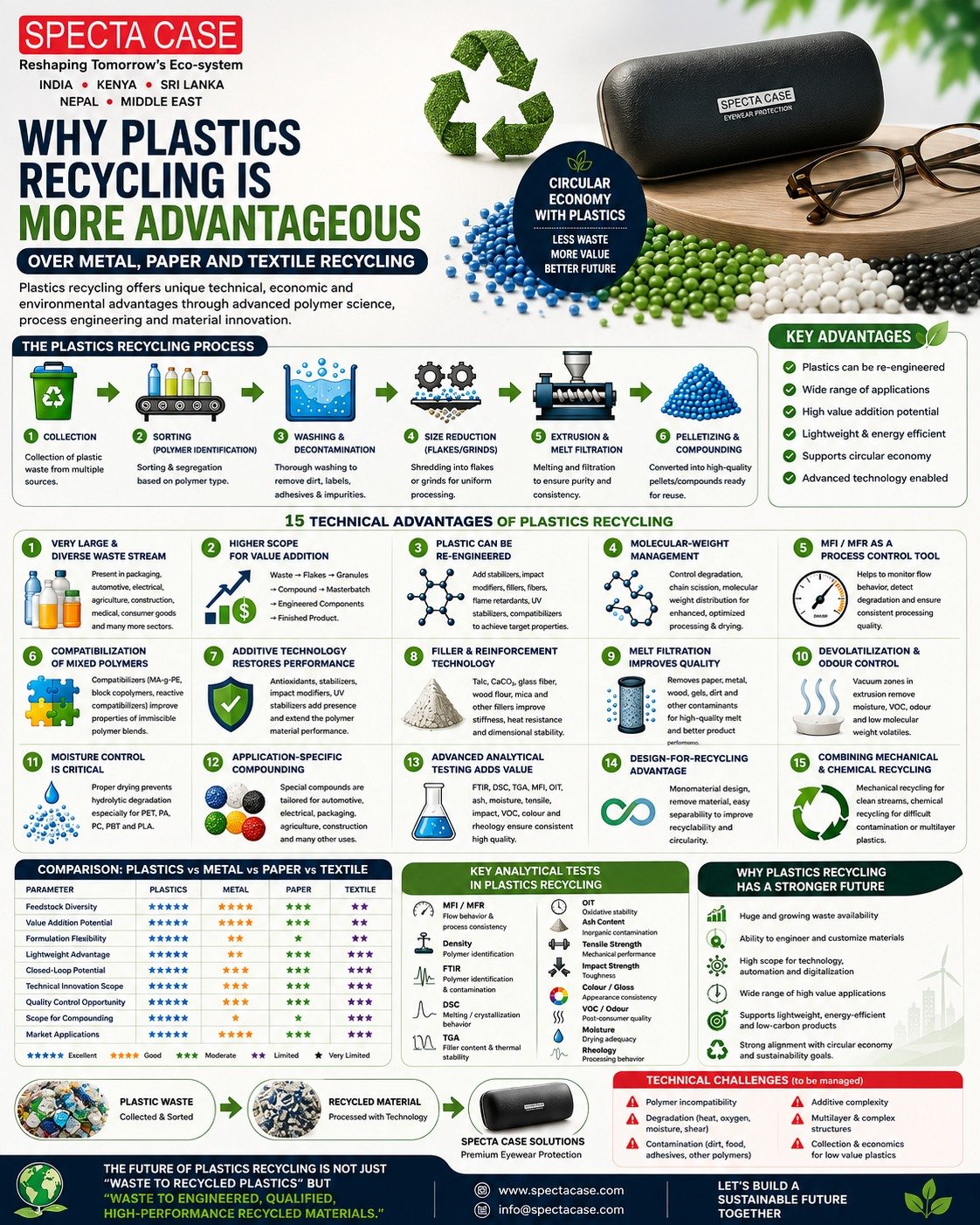
Plastic recycling is no longer simply about managing waste—it is becoming a powerful part of sustainable manufacturing, circular economy, and advanced material innovation. Compared with metal, paper, and textile recycling, plastics offer exceptional flexibility because recycled polymers can be processed, modified, compounded, and re-engineered for new applications. 🌍
♻️ From Plastic Waste to High-Value Material
The modern plastic recycling process begins with collection and polymer identification, followed by sorting, washing, decontamination, and size reduction into flakes or granules. The material can then undergo extrusion, melt filtration, pelletizing, and compounding to create consistent recycled plastic material.
One of the biggest advantages of plastic recycling is its ability to be re-engineered. Through molecular-weight management, compatibilizers, additives, fillers, and reinforcement technologies, recycled polymers can be developed for improved strength, flexibility, durability, heat resistance, dimensional stability, and processing performance.
Modern plastic recycling technology also supports application-specific compounding. Analytical testing such as MFI/MFR, density, FTIR, DSC, TGA, moisture, tensile strength, impact strength, flexural modulus, colour, gloss, VOC, and rheology helps monitor material quality and processing consistency. 🔬
🕶️ Specta Case: Turning Recycled Plastic Into Eyewear Cases
At Specta Case, plastic recycling becomes a real manufacturing application. We recycle and process suitable plastic material and use the recycled material to manufacture spectacle cases and eyewear cases.
Through our plastic manufacturing and injection moulding capabilities, recycled material can be transformed into functional plastic spectacle cases designed for durability, protection, appearance, and everyday usability.
This creates a practical journey from plastic waste → sorting → processing → recycled material → manufacturing → finished spectacle case. It demonstrates how recycled plastic can move beyond low-value applications and become part of a useful, engineered product.
🌱 Why Plastic Recycling Has a Strong Future
Plastic recycling offers a large and diverse waste stream, high value-addition potential, lightweight products, formulation flexibility, wide market applications, and opportunities for automation and advanced processing. It can support resource efficiency, sustainable manufacturing, and circular economy goals.
At the same time, challenges such as polymer incompatibility, contamination, degradation, additive complexity, multilayer structures, collection, and recycling economics must be carefully managed. Better sorting, quality control, design-for-recycling, and the combination of mechanical and chemical recycling can help overcome these challenges.
The future is not simply “waste to recycled plastics.” It is “waste to engineered, qualified, high-performance recycled materials.”
At Specta Case, we believe that turning recycled plastic into durable spectacle cases and eyewear packaging is one meaningful step toward a smarter, more responsible, and circular future. ♻️🌱